Contact
Try:
Game
pâtés or terrines
Hunting for the pic-nics of the next fishing season...
Small monkfish
tails à l'Armoricaine
As served by Noël LEFEUVRE.
Salmis de Palombes,
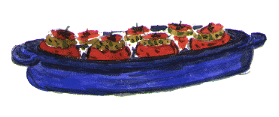
Woodpigeon red wine stew served in the Basque country.
Civet de Sanglier. Red wine stew for big game. And wild boar leg roasted in oven. "Cuissot de Sanglier" rôti.
La Soupe de
Poissons de roche
Small rock fish soup like in Marseille, Cassis, La Ciotat, Les Lecques
etc...
The Woodcock Bécasses rôtie à ma manière, and a few flies for woodcock lovers.
Le Calvados Two winter and one summer suggestions of use and the classic way.
Mule deer Tender fillet prepared Grand Veneur or poivrade.
Paëlla de la Albufera from the "Grao de Valencia".
Faisan Vallée d'Auge - Pheasant breasts like in Normandy. Winter greetings 2002.
Wild ducks - In the style of La Tour d'Argent's "canard au sang".
Game pâtés or terrines
Hunting for the picnics of the
next fishing season...
Small monkfish tails à l'Armoricaine
As served by Noël Lefeuvre,
in Brittany, when he invites us for a woodcock trip.
First
buy a bottle of MUSCADET.
If you intend to cook with friends and talk
in the kitchen, ... buy two !
Use a pan and a casserole.
In the casserole, put half the bottle of Muscadet, same of water, salt,
pepper, a carrot cut into slices, an onion cut as well, thyme, bay leaf,
parsley and boil about 30 minutes.
In the pan, put a big piece of butter and gently melt 250 or 350 grs of
mashed shallots.It must not take any other colour than pale blond.
After a while, add a
small glass of Muscadet and leave on fire untill wine smoothly
disappears.
Add a big spoon of concentrated tomatoes and mix.
Cook about 10 minutes the pieces of fish in the "court-bouillon" of the
casserole. Take them out, and get rid of the "court-bouillon".
Put your red "Armoricaine" sauce in the casserole. Add the rest of wine,
boil gently to get more thickness and turn the wine into sauce. Add salt
and pepper and taste to check. If it's too liquid or too "winy",
continue
to boil.
Put a big spoon of olive oil in the pan. Heat a bit and place the
pieces of
fish, moving and turning them gently. Again, it must heat but NOT take
any
kind of brown color.
When you reach a point of good heat, reduce fire and add a small glass
of
Brandy or Armagnac. Have a lighter or a match prepared. Burn the boiling
Brandy. Shake the pan during this operation. When all flames have
disappeared, put it all, fish oil, brandy, in the casserole where the
sauce
is waiting warm.
Don't boil anymore, you can leave it on very low fire for a while, but
basically now you can serve dinner. Place fresh cut parsley on top.
Please note: The art is to prepare a quantity of sauce perfectly
matching
the quantity of fish. As you notice, it ends up like a kind of stew.
Therefore, fish should be totally inside sauce, but not sort of deep sea
fishing in it !
This sauce recipe also applies for lobsters, but do not use the court
bouillon. Cut into pieces and break claws. Put in warm olive oil and
when
they're all well red, brandy flame them. Open head apart, take the good
red
things inside it and mix to the sauce. Places the pieces of lobster in
very
warm sauce for a while and serve. The lobster probably requires more
brandy
than for the burbot. Don't forget a little fresh parsley on top for the
green colour.
PS: some people say "à l'Américaine", and others "à l'Armoricaine". Both are correct.
Salmis de
Palombes
As served in the Basque country.
Take a wild pigeon,
roast it a short while in an oven. Take it it
out and
cut it in parts. Two breasts two legs, and the rest. Take the rest, skin
and other bones cut in pieces, put in a casserole with butter. Add a
small
carrot and an onion, also cut in small pieces, garlic, parsley, thyme,
let
it take colour, put a spoon of flour, mix, let it take colour again. Add
two glasses of strong red wine and a spoon of brandy, give some heat,
place
inside it the breasts and legs, then boil gently at low heat for an
hour.
Take the breasts out, press and strain the sauce on it. Sauce must be
thick. serve with mushrooms and potatoes. Sprinkle with a little of
fresh
parsley.
Red wine stew, to be used for a
tough shoulder, leg or fillet of boar or any other big game. In
Provence, this would be called a "Daube".
kitchen, wheat flour, 1 onion, a small carrot, one or two heads of
garlic, a thick and fat slice of smoked bacon (du lard fumé), a can of
mushrooms (or fresh ones), a bottle of strong red wine, salt pepper,
herbes de Provence, bay leaf, the smallest can of concentrated
tomatoes, fresh parsley.
Take a deep thick pot or casserole with a cover. Place butter and oil
in it and the little cubes of fat bacon. (You'll have cut your slice
before of course). The melting grease of the bacon flavours the fat.
Once warm, put the onion cut into pieces. The carrot cut into thin
slices.The garlic, and after a while the cubes of meat. Your fire must
be quite strong and you must move these things all the time. The meat
becomes grey and looses moisture. If you find it all too dry add some
oil.
Do that for around five minutes then reduce fire and put your fingers
in the flour pack, take what you can and sprinkle on the meat. The top
becomes white. Turn it all, the white disappears, everything dries,
dont let it burn but it must become dark brown. Do it again a
2nd time: Fingers in the flour etc... Then add your concentrated
tomatoes, 1 or 2 tablespoons no more. Mix it all again. Add your
mushrooms (well dried). Mix again and leave it a short while. (A wee
dram of Armagnac is allowed at this stage).
Add the wine, all the meat must be under the wine level. No more, no
less. Put the salt, the pepper the laurel leaf and the parsley
thoroughly cut.
Activate fire and let it boil frankly while moving it all continuously.
Scrapwell the bottom. Once it is boiling, reduce fire to minimum,
place cover on top and let it cook smoothly for two hours. That is the
word "mijoter". From time to time, you can lift cover, look and mix.
After these two hours, you stop the fire and let it rest covered another
hour. Then you can taste and see if you've put enough salt at the
beginning or if you must add more.
Leave it like this and if possible serve only the next day, after another hour
of very gentle heating.
This dish is served with boiled potatoes or rice or big noodles like
fresh tagliatelle or papardelle like in Tuscany.
If you proceed like this, the wine has evaporated a lot, the sauce is
brown and thick, but still all the meat is inside the sauce. If you
evaporate too much by leaving fire too strong, you can add some (half
a glass) water but never any crude wine.
Wild boars in Provence, Sept 2007
Marinate one night in 1 or 2 bottles of 75 cl of classic strong red
wine. The marinade must reach at least half of the leg, so when you
turn it up (every 3 hours), all parts will have been eventually
marinated.
In the marinade, put:
- A "cork" of wine vinegar and 1 of olive oil.
- Onions in slices
- Crushed garlic
- Carrot sliced.
- 1 branch of celery, bay leaf, pepper, and from the hills of
Provence: thyme, rosemary and a few of these juniper black berries.
The D-day, take the piece of venison out of the marinade, and any
time well before: Strain all the onions, carrots etc...
- Take a casserole, put olive oil and butter and dry and colour all
the strained onions etc...
- Add two big spoons of wheat flour on this, mix and let get it brown.
- Pour all the wine and first boil strongly then keep gently boiling
until well reduced.
- Add if you want a small glass of brandy or armagnac
- and a small piece of peeled lemon skin.
Keep this on fire for an hour. At the end it must look like a thick
sauce but in good quantity. Strain to keep only the liquid part. Do
not try to correct or re taste, just keep it warm.
Keep your meat all day out of the refrigerator. Pre warm your your
oven and place your venison on a steel dish. Put pieces of butter on
top, salt, pepper, herbs, and garlic "en chemise" on the steel dish.
Cook like a roast lamb leg for at least 1h30, more if bigger than the
usual lamb leg.
Pour small glasses of water or white wine in the dish during the stay
in oven. When you think that your leg is cooked, take it out and put
the dish on a gas to scratch all juices and do your best with water or
white wine to obtain a good concentrated tasty gravy. Put all the
gravy obtained in your wine sauce and now make the correction of salt
and pepper. Add also the blood obtained from the cutting mat again in
the wine sauce ...
NB: The sauce must be obtained in good quantity for the following
reasons: 1stly it is good and guests will use a lot with what they
eat. Then a leg of wild boar is rarely entirely eaten during a dinner.
When the dinner is finished, you must cut all the meat in thin slices,
and you will put everything in what remains of sauce. The next day you
just have to reheat this to finish your cuissot.
You can serve along, celery puree, or sauteed chestnuts or chestnut
puree, or even simply rice or boiled potatoes or mashed potatoes.
@+
Artichokes
"Barigoule"
As served in Provence along with
boar pâtés and cold meats.
Use it as a starter
dish, or like a small salad, it serves maybe 5
persons. Take: 10 tiny artichokes. 1 carrot. 2 thick slices of salted
or smoked bacon or cured ham.Olive oil, 1
clove garlic, 1 glass of white wine, the juice of a half limon, salt,
pepper, thyme, and an optionnal handful of
black olives.
Clean the artichokes by tearing off the exterior leaves, leave 2cms of
the tail, cut each artichoke in 3 slices
(cut vertically). Make little cubes of the carrot. You can add also an
optionnal red pepper, also in little cubes.
Make chunks with the bacon or the ham.
In a deep pan, heat olive oil, 1 clove garlic and the chunks of bacon
or ham. Add the vegetables, and sauté
them briefly. Add a glass of white wine, and the juice of a half limon.
Season with salt pepper and thyme. An optionnal
handful of black olives is also good. Simmer for 15, 20 minutes.
You are not supposed to eat this hot. This dish is good the next day
after a night in the fridge, but the best
temperature is obtained if you do it one hour before the meal, by just
leaving, somewhere in the kitchen waiting
for beeing served.
Soupe de
poissons de roche
A BEST SELLER OF THE FRENCH
CUISINE (Special for young fishermen).
I have noticed among foreign visitors that the fish soup
prepared like in Provence, always meets an incredible success. This dish
looks like "wizard" work that only a few "Chefs" can do but the reality
is
much simpler. It is actually one of the easiest dishes that can be
obtained
with a mixture of love and simple products. Why love ? 1st because you
should put some in anything you cook, and 2nd because the fish soup is
THE
PRIDE of very young fishermen. In my own memory, "la soupe de poissons"
is
probably the most beautiful fisherman souvenir. When you're 10 years
old,
anything you hook around 3 inches long is already "big game" fishing and
going back home with a plastic bucket full of shiny prays make you feel
like... Well nothing compares ! In the future "perfect world" some
people
are building, young kids will probably be told that it is cruel to go
fishing, but before this delicious moment you can still enjoy your
summer
holiday, waiting for the "fishermen's return" and get prepared to
another
pride: Preparing la "Soupe de Poissons".
You need a kid's bucket of very fresh (non silty*) small fish. Olive
oil.
Two big potatoes, two big tomatoes, 1 big onion, 2 or 3 garlic "teeth",
salt, pepper, a bit of saffron, thyme, bay leaf, and 1/2 pint of water
for
each person.
Get roughly rid of fish bowels but keep heads and tails and all the
rest.
First heat your olive oil with the garlic, the onions and smoothly add
the
fish and let it fry for a while. Add also the tomatoes and potatoes that
you have cut into small parts.
When it is all warm "singing" enough, put the water and season
accordingly
with salt, pepper, saffron, thyme, bay leaf etc...
Boil until the moment the potato pieces are starting to disappear.
Pass it all through a strainer, taste and add salt or pepper
if needed.
It must be served with slices of French type bred, toasted in the pan
with
olive oil and garlic. You can also put on the table grated
"gruyère" cheese
that you spread over soup and toasts, in the plate and this special
spicy
mayonnaise called "rouille". La "rouille" is obtained very simply by
making
a normal mayonnaise in which you incorporate a mashed garlic "tooth"
plus a
bit of saffron making the "rusted" colour.
I am not sure all kids will enjoy the dish but adults surely will
especially if a chilled rosé or dry white good wine comes along.
But all
kids will be proud to see parents and friends enjoying result of their
hard
fishing days.
*Small colorful sea "rock-fish" like in the Mediterranean sea are the
best.
However, almost any fish can be used. Almost each region of France has
its
"soupe" and all species of fish are used.
The roasted
Bécasse à ma manière !
The "bécasse aux
bowels" as it was named by Kirk Hogan...
Firstly "wait" your woodcock, hung
by the neck outside in feathers for between
five days and a week or ten days. If weather is very cold, the longest,
then warmer days shorter stay.
When the bird is ripe, get rid of (some), feathers, keep some others
for your next fly fishing season. I'll be
back on these later, (1).
And start a the same time two "cullinary works" being:
1/ La Bécasse (the woodcock) & 2/ La rôtie. (The toast)
La Bécasse.
Make a delicate incision on belly
and put all the "insides", on a cutting
matt.
Take the bird in your left hand and the head (still attached but eyes
ripped off), in your right one. And, "à
la mode classique", push firmly the bill through the legs at level
of the knees.
Melt some butter in your fingers and proceed a massage of bird's body,
then put salt and pepper .
Bird is (or birds are) placed on a steel dish and put inside hell fire
oven, acompanied by one or two garlic teeth
"en chemise" (keeping the outer skin).
La Rôtie: (The toast) (2)
Chopp the "insides" with a good
knife. (Get rid of the gésier, little
hard ball). Put them in a small casserole with a "nut" of butter, on
not too warm a fire.
You quickly see a smooth transformation (difficult to explain) of
colour and aspect. When it's all "transformed"
like after 3 or 4 minutes, take some wheat flour with your finger and
pour in rain on this. Mix thoroughly and
wait another minute.
Add a drop of Armagnac, and heat a bit more. Prepare a lighter, when
you see its OK, Fire ! Whaoum !!! the Armagnac
flambe... take away from fire mix again thoroughfly adding very little
of salt and pepper. Leave it apart, it looks
like a brown paste.
The toast themselves are pieces of
bread that you should have left "on air"
since yesterday. Fresh bread doesn't work for this.
Heat some oil in a pan and roast (or better said, fry) the bred slices
on both sides. Blond is the coulour to obtain
and surface of bread must be crusty. French bread works well but white
bread US or UK style also. (I guess a good
baker's loaf will work better than industrial Mother's pride or
whatever).
If you take a French baguette as a measure, you should get two toasts
(cut into slices shape) per bird. So if it's
the big square Anglo Saxon bred, one toast cut in two triangles will do.
When these are blond (this operation can be done as # 1st, any time
before), place them on a grill or on absorbing
paper to get rid of some fat.
Take your casserole with the insides and Armagnac preparation and
spread over the toasts.
Back to the Bird.
It must be "golden brown", like any roast chicken or partridge. It must
be well cooked everywhere but
absolutely not dry. It's an art !
Also it must produce a nice gravy singing (but not burning) in the
steel dish.
Garlic must offer no resistance to a fork. If it is still hard, it
usually means that birds are not cooked enough.
It mostly depends on the number of birds. 8 birds will need more time
than 6, needing also more time than 1 or
2.
Usually with 30 minutes it is all OK.
Now you think your birds are "to the point", so switch off oven and
follow me:
1/ Bend birds on the steel dish to get all the gravy that is inside.
2/ Place the birds waiting somewhere where they won't get cold.
3/ Place your toasts inside still hot oven.
4/ Put your steel dish on a fire. Scratch bottom with a fork. Mash with
the fork one of the garlic teeth. Add a
drop of the red wine you will drink at the table, plus a very small wee
of Armagnac and a (5 or 6) few drops of
lemon juice. Add a little of thyme, correct salt and pepper, let it
boil once and put in a warm saucepan. Result
must be brown.
Put one bird on each (hot) plate with the two toasts around but the
gravy apart. Just use the gravy gradually,
toasts are not gravy sponges !
No vegetable is expected at this moment of the meal. A salad as a
follower should be enough for today.
Make sure you remember that Armagnac and wine must be used with great
discretion and musnt mask in any way the
taste of gravy or be too present on the toast. (Neither should the
lemon, only the cook must know that this light
acid touch comes from lemon. If someone recognizes lemon... you'll just
do better the next time).
Eat "comme des cochons"... (like pigs), there must be no
leftover of flesh on any bone.
I finally cant resist paraphrasing Alexandre Dumas at the end
of his snipe recipe called: "Salmis
des moines Bernardins". (In L'Almanach des Gourmands année
1806)
"You will pay great attention to giving forks to the guests in
the fear they could devourish their fingers
if those had touched the sauce" !
And as we speak of "litterature", you can also end up with the
tradition of the "... Dîner
des bécasses du baron des Ravauds" of Guy de
Maupassant in Contes de la Bécasse.
Take an empty bottle of claret, replace cork on top and a
pin on the cork. Set a woodcock head on the pin,
place it all at the center of the table. Ask an innocent hand to push
bill and make the head turn. When the bill
stops it must be pointing one of the guests. This one has the privilege
to eat all heads but must tell a good long
story to the others while they light a cigar and sip their Brandy
warmed up by the flames in the fireplace. (If
you want the story to be good, watch out the number of bottles you
serve, the right point is between generously
and too much).
Very friendly / Nick
(1)Flies for Woodcock hunters
Woodcock can replace patridge and
grouse in many classic British wetflies and was
used for wings of many French salmon "mouches paysannes" in
Brittany.
-For dry flies, the dotted soft hackles can also double the usual cock
hackles on many flies, especially big mayflies.
-Brown stiff feathers on wings can also be cut in shape and varnished
for caddis wings.
- But the most interesting are the small feathers situated around the
"glande uropygienne", they are
the equivalent of duck's CDC.
They are of two sizes, large and small.
1st, The large feathers,
With the larges ones, take a hook
# 14 that you wrap with olive or frankly green,
floss. Put no tail.
More or less in the middle of the shank, "pinch tie" the feather tip as
you would do to obtain a fluttering
caddis.
Turn butt part as a hackle. Form head.
Result is a wonderful small caddis with very nice dotted legs.
2nd The small feathers,
On a # 16 hook, wrapped with yellow
floss and featuring a small tail.
Take a matching pair of these feathers, tie as wings, divided, upright
or spent, style.
Butts are pointing towards bend.
Once you've finished your "8" knots, bring the butts back towards eye
(seperating the two wings).
Form head.
What you've left between the two wings should produce effect of thick
thorax.
In fact it is a CDC pattern but result is much nicer with woodcock's
"lypopiges" . These flies have to
be used on a rising fish driving you crazy, by refusing all the rest of
your box. They are "last chance secret
weapons".
They need no grease or muce as they are naturally greased. Once they're
wet, it's finished for them.
Another dry fly ...
Was originally tied with drake
flanks by Henri Bresson the "Wizard
of Vesoul" (father of French tricolore patterns). This one is known as
la "Peute"... (villaine)
On sizes # 14,16,18, wrap a yellow body, not too thick and not reaching
bend. (Like for a spider)..
Tie one of the small flank feathers as any soft hackle.
Form head. Cut what goes off the bend.
Use like a spent as a dead... "somethingbutwhat", or hatching Phryganes
is often said ? (But it works).
I suggest you to try these flies on very frequented US rivers where all
trout could give lessons to Halford ! I
am quite confident they havent seen these too many times !
(2) Note for people taking French classes
The word "rôtie" sounds more like roasted piece of meat,
but the ancient translation for
toast was "rôtie". Now we use the english word "toast" for
breakfast or tea time but
"rôtie" or "croûtons" in this case. However, "rôtie"
is more proper.
A roast beff would spell "rôti" without "e" at the end.
How to use calvados once you are back on the Henry's Fork of the Snake River. March 2001 for my friend Ben Widman.
Dear Ben,
With the Calvados we are currently doing the following preparations:
Winter suggestion (Sometimes
named "Chabraninof" (See below)
Take a couple of apples and cut in thick slices.
Fry in the pan with butter to the point golden brown and smooth.
Flambé generously with calvados.
Serve hot on vanilla ice cream.
******
Summer version.
Apple sherbet
On which you pour a glass of calvados
It is a modern version of the trou normand.
It is supposed to reopen widely your appetite between two big dishes at
a banquet !
*******
Duck hunter's winter hot water.
Simply named an "eau chaude" among Normandy duck hunters.
A shot of calvados
A piece of sugar
hot water
Isn't it a simple recipe ?
******
Otherwise still simply as a Pousse café (push coffee)
A shot in your empty but still warm coffee cup
or straight of course.
Chabraninof !
Open here to ow to see the process step by step with pictures
Mule
deer tender fillet Grand Veneur
Answering the question of an
American hunter, I would :
- Marinate one night in 75 cl, classic strong red wine, with
- Onion
- Garlic
- Carrot sliced.
- 1 branche of céleriac, thyme, bay leaf, pepper.
The D-day, I would take the piece of venison out of the marinade.
Any time well before: Strain all onions and so forth.
- Take a casserole, put oil and butter and dry and colour all the
strained onions etc...
- Add two small handfulls of wheat flour on this.(mix)
- Pour all the wine and first boil strongly then keep gently boiling
untill well reduced.
- Add if you want a small glass of brandy or armagnac
- and a small piece of peeled lemon skin.
Keep this on fire for an hour. At the end it must look like a thick
sauce but in good quantity.
Add salt to taste at this moment.
Your sauce looks good but is... disgusting !
do not try to correct or re taste, just keep it warm.
Keep your meat all day out of any kind of refrigerator.
Keep your oven hell warm.
When your guests are ready, place your fillet on a steel dish.
Put pieces of butter on top, salt, pepper, herbs, and garlic en chemise
on the steel dish.
Cook promptly, to the rare or medium rare point.(Maybe half an hour ?)
Pour very small glasses of white wine in the dish during the stay in
oven.
When you think your filet is OK, take it out and do your best to obtain
a good concentrated tasty gravy.
Put this gravy in your wine sauce and now the miracle ! your work is
just perfect !!!
Prepare a service steel dish, heat it.
Cut you slices of rare filet.
Place nicely in the service dish,
add the blood obtained from cutting mat again in the wine sauce ...
and now it is superb !
Make a topping of very warm sauce on the slices. (For this reason, like
in the canard au sang, there is no problem
if your meat is a bit too red as the warm sauce on the thin slices is
completing the cuisson). The more it is rare,
more it is soft and tender.
Add some very green fresh parsley on top before serving.(for the eyes)
Serve with wild native American rice or boiled potatoes.
@+
Paëlla
de la Albufera
In loving memory of the late
"Pepica", of the "Grao de Valencia". (La Pepica is mentioned by Hemingway in his
Dangerous Summer, after he ate there with Ordoñez. There is a
great -and large- picture of them in the dining room recalling this
moment).
In 8 easy steps...
By Nick - Gourmetfly.com
1- Buy the most classic old fashioned round rice cooking in 20 minutes.
Italian rices sold for risotto are perfect.
2- Check how many people your paëllera can serve. Pour as many
coffe cups as you can until you reach the rivets
of the handles. Divide per two, this is the number of guests. You
need more or less 70 to 100 grs of
rice per guest, but your paëlla will always be at its best when
realized for the quantity required by the
steel dish called paëllera.
3- Prepare your fire and put a nice coat of olive oil on the bottom of
the paëllera. Put a handful of garlic teeth
in the oil. Put your meat or fish cut in small parts in the oil and
brown gently. Add salt and paprika on the meat
or fish. Be greedy with the meat or fish, the paëlla is a rice
dish. The rice is the star.
4- Add on this the content of a small size tin of peeled tomatoes cut
in small pieces -pomodori pelati- Once the
tomatoes are well hot and boiling, add the rest of vegetables. (Spinach
leeves, small artichokes, green flat beens,
red or green pepper).
5- Once all this is well hot and boiling, add the required quantity of
water divided in coffee cups. Season the
water with salt, and saffron. The best herb -if not the only suitable-
is the rosemary (romero in Spanish). Once all this is well hot and
boiling, add the required
number of rice as: number of water coffee cups
divided by 2. Make regular crossed rows when pouring the rice. Equalize
thoroughly and do not touch it anymore.
6- Leave it on gentle fire for 20 minutes.
7- After 20 minutes if it looks very dry, just take it away quickly
from the fire -that you should have calmed
down before- If it looks fine but rather wet, give a violent fire for 1
minute. When the paëlla is made outside
on a woodfire we press it hard against the red hot cinders for a minute.
8- Place the paëlla on the dinner table but wait 10 minutes
before serving. Fresh quarters of
lemon are a nice decoration and season both meat or fish paëllas.
Approveche or bon appétit !
Cheers / Nick
Faisan
Vallée d'Auge
Pheasant breasts in the
Normandy style.
One bird serves two as the legs would better go in a terrine.
This is an easy recipe as you do not need to properly
pluck the birds. You can even use the two breasts only after removing
them simply with a knife. This recipe also
applies to good chickens and guinea-fowls. Le Pays d'Auge is the Norman
countryside of Deauville and Honfleur.
The Norman chalk-streams are flowing across dairy meadows -for
camembert cheese- also planted with old apple trees
producing cider and calvados.
The first step is to cook tender and brown quarters of two Golden type
apples. The apple quarters must be skinned
then sauté with a pan in a mixture of oil and butter. When they
are done and well tender, just let them
wait apart in a plate.
In the same pan, put more butter and melt a crushed clove of garlic and
a chopped shallot or small onion. Season
the two breasts and the legs with salt and pepper and gently cook them
sauté in the perfumed butter. When
the breasts are well coloured, reduce fire, cover and simmer 5 minutes
then put them in the waiting plate with
the apples.
Deglaze with a blend of 5cl (3 fl oz) cider vinegar and the same of
Calvados. If these essential raw materials
were missing, Jerez vinegar and Armagnac or brandy would be fine. Put a
flame on, and flambé ! briefly the
Calvados. Add a small pot of fresh (or double) cream -200/250 grs or 7
fl oz- mix and scrape the pan with your
wooden spoon and let this sauce become brown and thicker. Season the
sauce with salt and pepper. Put the apples
in the sauce, mix and place the breasts in the center. Cover the pan
and simmer again five or ten minutes on very
moderate fire. The presentation trick is to see the nicely coloured
breasts surrounded by the appetizing sauce
but not covered by the sauce. A small sprinkle of fresh green parsley
on top always adds to the beauty of the dish.
Serve with white rice. Drink a white Burgundy or any light red of your
taste and don't forget a toast to the old
friends.